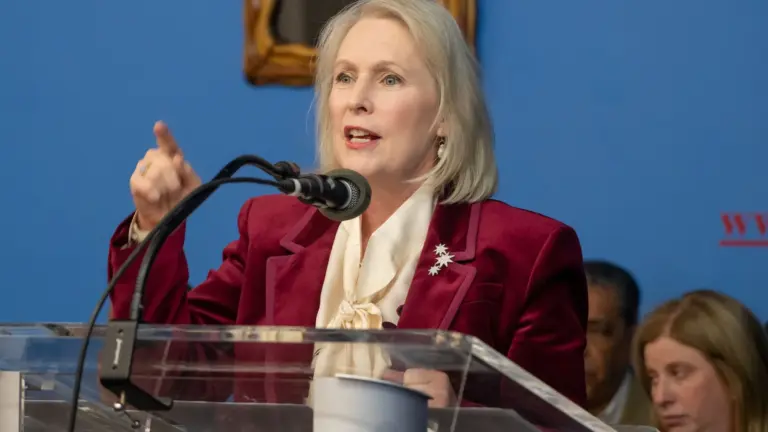


Image credit: Shutterstock
Chris Larsen, Ripple’s co-founder and executive chairman, has reportedly backed American Perpetuals Exchange Corp., a derivatives startup founded by Theodore Gillibrand, the son of U.S. Senator Kirsten Gillibrand.
APEC is seeking to build a regulated U.S. venue for equity and stock-index perpetual futures, not crypto contracts. The investment adds political sensitivity because Senator Gillibrand remains involved in Senate digital asset market-structure talks and ethics negotiations.
Larsen Joins APEC’s Reported $30M Investor Group
Larsen was identified in reports as one of the investors in APEC, a new derivatives venture founded by Theodore Gillibrand. His exact investment amount was not disclosed, while most investors in the reported group contributed between $5,000 and $10,000.
The company had already drawn attention after raising $30 million in a funding round led by Lux Capital, giving it a valuation of about $300 million.
Other backers named in reports include hedge fund manager John Griffin, investor Mark Ein and Palmer Luckey. The investor list gives APEC a mix of venture, finance and technology-linked support before it has secured the regulatory approvals needed to launch its market.
APEC Targets Equity Perps, Not Crypto Contracts
APEC is not planning to launch as a cryptocurrency exchange. Its stated plan is to list perpetual futures tied to U.S. equities and stock indexes, rather than digital assets.
Perpetual futures, often called perps, are derivatives that do not have a fixed expiration date. Traders use them to take long or short exposure to an underlying asset without holding the asset itself, with funding-rate mechanics helping keep the contract price aligned with the reference market.
That structure became popular in offshore crypto trading, but APEC is trying to move the model into U.S. regulated equity markets. The distinction is important: the company is crypto-adjacent because of the product’s history and some investor backgrounds, but its launch plan is focused on traditional securities-based markets.
SEC Filing Points to CFTC and SEC Oversight
APEC’s regulatory path is the core of the story. A presentation filed with the Securities and Exchange Commission says the company intends to apply for a Designated Contract Market license with the Commodity Futures Trading Commission and seek a special exemption to list perpetual futures on single-name equities under joint CFTC and SEC oversight.
The same filing says clearing would run through a registered derivatives clearing organization. It also frames regulated perpetual futures as a way to bring activity that may otherwise move offshore into U.S. jurisdiction, with margin rules, position limits, surveillance, KYC, AML checks and disclosure.
That approval path is not automatic. Equity-linked perpetual futures sit near the boundary between futures regulation and securities oversight, which means APEC would likely need both market-structure permission and interagency coordination before it could offer the products at scale.
CFTC Bitcoin Perp Approval Opened Wider Debate
APEC’s plan comes shortly after the CFTC approved KalshiEX to list a Bitcoin perpetual contract as a futures contract. The agency said Kalshi submitted the BTCPERP contract for review on May 28, and the CFTC issued an approval order on May 29.
That decision gave U.S. venues a regulated opening for a product category long associated with offshore crypto exchanges. However, the CFTC also said perpetual contract design may not be suitable for every asset class and encouraged market participants to seek review for products outside the approved order.
The regulatory debate is already contested. CME has sued the CFTC over the agency’s move to allow Kalshi and Coinbase to offer perpetual futures, arguing the contracts should be treated as swaps under Dodd-Frank rather than futures.
Gillibrand Denies Role in Son’s Startup
Senator Gillibrand has said she has no involvement in her son’s business. A spokesperson repeated an earlier statement that Theodore Gillibrand is an adult starting an independent company and that she is not involved in it.
Theodore Gillibrand recently graduated from Stanford and previously worked at crypto investment firms including Paradigm and Andreessen Horowitz. That background helps explain why APEC has drawn attention from crypto policy reporters even though the company says it does not plan to offer crypto contracts.
The sensitivity comes from timing and proximity, not from any reported finding of wrongdoing. Larsen is a prominent crypto industry figure, while Senator Gillibrand has been one of the Senate Democrats involved in digital asset legislation and market-structure negotiations.
CLARITY Ethics Fight Keeps Pressure on Talks
Gillibrand has pushed for ethics language in the Digital Asset Market Clarity Act, saying the bill cannot advance in the Senate without provisions limiting crypto-related industry ties for senior government officials.
The ethics debate has focused largely on whether senior officials, members of Congress, presidents or vice presidents should be able to profit from crypto-related industries while shaping the rules that govern them. Gillibrand has argued that unresolved conflicts could damage both the legislation and the industry’s credibility.
Larsen’s reported investment does not make APEC a crypto exchange, and no report has said his backing affected the CLARITY Act negotiations. Still, the overlap between crypto-linked investors, new derivatives venues and congressional market-structure talks adds another politically sensitive thread to Washington’s digital asset debate.
APEC’s Next Test is Regulatory Approval
APEC has raised enough attention to enter the market-structure conversation, but its business depends on approvals it has not yet secured. The company still needs to move from a financing story to a regulated exchange application that satisfies the CFTC, the SEC and any clearing requirements attached to its proposed products.
For crypto markets, the broader issue is whether products popularized offshore can be rebuilt inside U.S. rules without weakening investor protections or creating new conflicts around market access. Perpetual futures have become one of the clearest tests of that question because they combine continuous trading, leverage, funding payments and cross-agency jurisdiction issues.
For Washington, the next question is whether crypto market-structure talks can survive the ethics fight while industry-linked ventures continue to draw scrutiny. For APEC, the next step is more concrete: proving that a regulated U.S. equity-perps venue can clear the legal, technical and political hurdles ahead.