
Image Credit: Shutterstock
Key Takeaways
- Bitcoin miners have announced an estimated $70 billion in cumulative AI and HPC contracts, with valuations now tied to compute infrastructure rather than bitcoin.
- Mining stocks rose more than 50% this year while bitcoin fell 17%, as listed miners could derive up to 70% of revenue from AI by year-end.
- Miners who spent years securing grid-connected power already solved AI’s hardest bottleneck without knowing it.
One of the defining industrial stories of 2026 in crypto is the accelerating conversion of Bitcoin mining facilities into artificial intelligence data centers, a shift that has sent mining stocks higher even as bitcoin has fallen sharply this year.
An estimated $70 billion in cumulative AI and high-performance computing contracts have been announced across the public mining sector, with valuations increasingly tied to contracted compute infrastructure rather than bitcoin alone.
Grid-Connected Power Became Bitcoin Miners’ AI Advantage
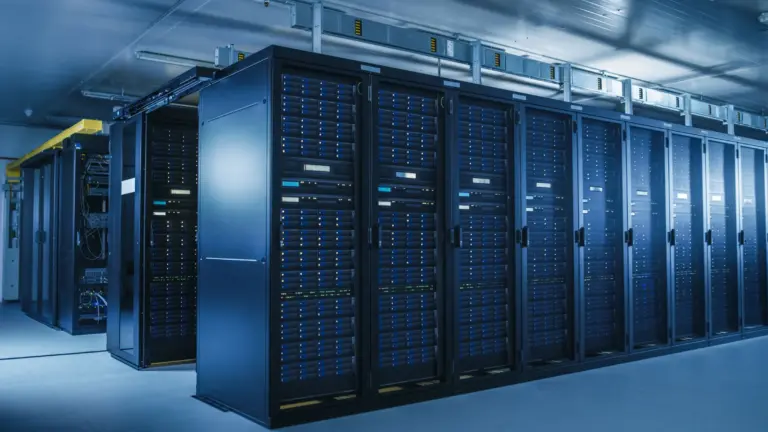
Bitcoin mining and AI data centers share more than a casual resemblance. Both need vast amounts of power delivered reliably, grid-connected real estate in suitable locations, and sophisticated cooling systems. The difference is the computing hardware inside and the economics it produces.
When Bitcoin miners built out their facilities over the past decade, they were assembling exactly the kind of physical infrastructure AI workloads now require.
According to CoinShares, the cost differential between building bitcoin mining infrastructure, at roughly $700,000 to $1 million per megawatt, and building AI infrastructure, at $8 million to $15 million per megawatt, is dramatic. AI offers structurally higher and more stable returns, which is why the conversion math keeps working in its favor.
The bigger structural advantage is timing. Grid connection wait times in major U.S. markets now stretch beyond four years in some regions. Miners who spent years securing energized capacity already solved the single hardest problem in the AI buildout without knowing they were doing it.
Long-Term AI Deals Are Turning Miners into Data Center Operators
The deals being signed make the scale of the transition concrete. Hut 8 secured a 15-year, $9.8 billion lease for its Beacon Point campus in Nueces County, Texas, a 352-megawatt facility built to NVIDIA’s DSX reference architecture, lifting its total contracted AI capacity to roughly 597 megawatts.
TeraWulf signed more than $12.8 billion in long-term, credit-enhanced customer contracts through the end of 2025, according to its full-year earnings filing, with HPC leasing revenue overtaking bitcoin mining income for the first time in the first quarter of 2026.
IREN secured a five-year, $9.7 billion AI cloud contract with Microsoft in November 2025, confirmed in an SEC Form 8-K filing, covering NVIDIA GB300 GPU deployments across 200 megawatts of liquid-cooled capacity at its Childress, Texas campus.
Core Scientific represents one of the most aggressive conversion plays. The company is transforming 300 megawatts of gross power capacity at its Pecos, Texas campus, previously dedicated to bitcoin mining, into an AI data center campus, with plans to scale toward approximately 1.5 gigawatts of gross power at that site alone, according to its April 2026 SEC filing.
Core Scientific sold $175 million worth of bitcoin in March 2026 to help fund the transition, liquidating 1,992 BTC alongside other major miners who have divested cryptocurrency holdings to finance infrastructure buildouts.
The financial logic of these contracts differs fundamentally from mining economics. Under a triple-net lease structure, the tenant, typically an AI firm or hyperscaler, pays rent plus all operating costs including power. The miner captures recurring infrastructure revenue without absorbing the enormous ongoing electricity costs associated with running large-scale AI workloads.
Cheap Nordic Power Draws the Next Wave of AI Infrastructure
The European side of this shift is playing out in the Nordic region. Norway and Finland offer some of the lowest industrial power prices in Europe, backed by hydroelectric and nuclear baseloads that provide the stable long-duration electricity AI workloads require. Cold climates sharply reduce cooling costs, which represent a significant portion of operating expenses for any high-density compute facility.
Several infrastructure developers have moved to secure capacity in those markets ahead of demand. The economics are similar to those driving U.S. conversions: cheap, clean, reliable power in locations where grid access can be secured years ahead of competing facilities.
Mining Stocks Have Decoupled From Bitcoin
While bitcoin fell roughly 17% through the first months of 2026, a basket of bitcoin mining stocks rose more than 50%, with the best performers up more than 70%. That divergence is the clearest market signal of what is happening. Investors are no longer valuing these companies primarily on hash rate, block rewards, or bitcoin’s price.
Listed miners could derive as much as 70% of their revenue from AI by the end of 2026, up from roughly 30% earlier this year, according to CoinShares. Core Scientific’s AI colocation revenue already accounts for 39% of its total. TeraWulf is at 27% and rising, with HPC leasing now its primary revenue driver.
IREN is at 9% but scaling rapidly toward a target of $3.1 billion in annualized recurring revenue by year-end, backed by its Microsoft contract and additional agreements with Together AI, Fireworks AI, and Fluidstack.
That trajectory means many of these companies are increasingly better described as data center operators that also happen to mine bitcoin. The question for the second half of 2026 is whether the companies that continue running both businesses can manage the capital demands of operating at scale while the power grid itself becomes the most contested resource in the digital economy.