How to Buy Bitcoin: Exchanges, Wallets, Taxes, and Security

Bitcoin is the cryptocurrency that started it all. Launched in 2009 by the pseudonymous Satoshi Nakamoto, it remains the most recognized, most traded, and most widely held digital asset in the world.
For anyone curious about getting into cryptocurrency, Bitcoin is the natural starting point. It has a longer track record than every other digital asset, the deepest liquidity pools, and the widest availability across exchanges and investment platforms globally.
Interest in Bitcoin comes from many directions: long-term store of value, fast international payments, or institutional portfolio diversification. Whatever brings you here, this guide assumes no prior knowledge. By the end, you will know how to buy, store, and manage Bitcoin safely.
Key Takeaways
- Buy Bitcoin only through regulated exchanges, enable two-factor authentication, and consider moving holdings to a personal wallet rather than leaving them on the platform.
- You do not need to buy a whole Bitcoin; fractions called satoshis are standard, but track every transaction from day one, as tax obligations begin at the point of purchase.
- Never share your seed phrase with anyone, for any reason.
What Is Bitcoin?
Bitcoin was introduced in October 2008 through a white paper published under the name Satoshi Nakamoto, whose identity has never been confirmed. The network went live in January 2009.
The first real-world transaction occurred in May 2010, when a programmer paid 10,000 BTC for two pizzas, now celebrated as Bitcoin Pizza Day. From negligible early prices, Bitcoin surged to nearly $20,000 in 2017, crashed, recovered, and exceeded $65,000 by late 2021, drawing new buyers and institutional interest with each cycle.
How Bitcoin Works
Bitcoin is a decentralized digital currency with no central bank, government, or controlling company. It runs on a blockchain, which is a public ledger of every transaction ever made, maintained simultaneously by tens of thousands of computers, called nodes, around the world.
When you send Bitcoin, the transaction is broadcast to the network, verified by nodes, and permanently recorded in a block cryptographically linked to all previous blocks. Altering any historical record would require redoing the computational work for every subsequent block and outpacing the entire network, and this is practically impossible.
New Bitcoin enters circulation through mining, where specialized computers compete to add transaction blocks and earn newly created Bitcoin as a reward. Total supply is capped at 21 million coins, which Bitcoin advocates compare to gold’s scarcity.
Where to Buy Bitcoin
Bitcoin is available through more channels than ever before, from regulated exchanges and brokerage apps to Bitcoin ATMs and peer-to-peer platforms. Choosing where to buy depends on your priorities around cost, convenience, and custody.
Platform Comparison at a Glance
| Platform Type | Typical Fees | Regulation | Beginner-Friendly | Self-Custody Possible |
|---|---|---|---|---|
| CEX (e.g. Kraken) | 0.1–1.5% | Regulated | Yes | Yes |
| Spot Bitcoin ETF | 0.15–0.25% p.a. | Regulated | Yes | No |
| P2P (e.g. Bisq) | 1–3% | Varies | No | Yes |
| Bitcoin ATM | 8–15% | Varies | Moderate | Yes |
Note: When learning how to buy Bitcoin, keep in mind that some investment apps, including Robinhood in the US, allow you to buy Bitcoin but do not permit withdrawals to a personal wallet. This means you are exposed to the platform’s solvency and cannot take self-custody of your Bitcoin. Understand this limitation before choosing a platform.
Centralized Exchanges (CEX)
For most beginners, a centralized exchange is the easiest and safest entry point. These are companies that operate platforms where buyers and sellers of cryptocurrency can transact. You create an account, verify your identity, deposit funds, and buy Bitcoin much like you would buy a stock through a brokerage.
Popular options include Kraken, Gemini, and Coinbase in the United States; Luno is widely used across Africa, Europe, and Southeast Asia; Binance.US operates in most US states.
What to Look for When Choosing an Exchange
- Regulatory compliance: Licensed and registered with the relevant financial authority in your jurisdiction.
- Fee structure: Clear and transparent, with no hidden costs.
- Deposit methods: A range of convenient options to suit your needs.
- Security track record: Research how long the exchange has been operating, whether it has experienced hacks or withdrawal restrictions, and what independent reviewers say about its customer service.
Spot Bitcoin ETFs
If you have an existing brokerage account and prefer not to manage cryptocurrency wallets, spot Bitcoin ETFs offer a straightforward alternative. In January 2024, US regulators approved the first spot Bitcoin ETFs, allowing investors to gain price exposure to Bitcoin through traditional investment vehicles.
Major offerings come from BlackRock (iShares Bitcoin Trust), Fidelity (Wise Origin Bitcoin Fund), and several others.
The key difference from buying Bitcoin directly is that with an ETF, you do not own the underlying Bitcoin; the fund holds it on your behalf. You cannot withdraw or spend the Bitcoin itself, and you pay an ongoing management fee. ETFs are well-suited to investors who want Bitcoin exposure within a tax-advantaged account such as an IRA or 401k, or who are simply more comfortable with traditional brokerage infrastructure.
Peer-to-Peer Platforms
Peer-to-peer (P2P) platforms such as Bisq allow buyers and sellers to transact directly, often with greater privacy and without mandatory identity verification. These platforms can offer more payment flexibility but come with higher scam risk and require more caution from the buyer. They are generally not recommended for first-time buyers.
Bitcoin ATMs
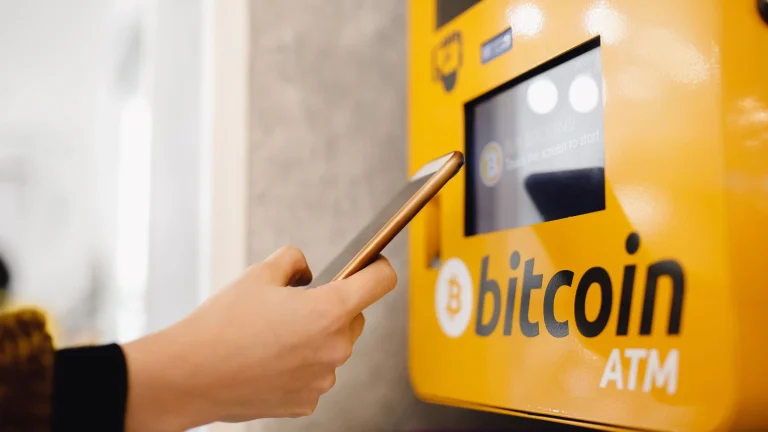
Bitcoin ATMs are physical kiosks that you can find in shopping centres, petrol stations, and convenience stores. They allow you to buy Bitcoin with cash or a debit card. They are convenient but typically charge high fees, often 8-15% above the market rate. To find a Bitcoin ATM near you, coinatmradar.com maintains a comprehensive global directory.
How to Buy Bitcoin: Step-by-Step
Once you have chosen an exchange and created your account, buying Bitcoin is straightforward. The steps below walk you through the process from verification to completing your first purchase with confidence.
Step 1: Create and Verify Your Account
Go to the website of your chosen exchange and sign up using your email address. Most regulated exchanges require identity verification (Know Your Customer, or KYC) before you can make your first purchase.
You will typically need to upload a government-issued photo ID (passport or driving licence) and sometimes a proof of address such as a utility bill or bank statement. Verification can take anywhere from a few minutes to a couple of days depending on the platform.
Once your account is created, immediately enable two-factor authentication (2FA). This adds a second layer of security by requiring you to confirm logins and withdrawals with a one-time code from an authenticator app (such as Google Authenticator or Authy) or a hardware security key. Avoid SMS-based 2FA if possible, as SIM-swapping attacks can bypass it. Never skip this step. It is the single most important security measure you can take for your exchange account.
Step 2: Fund Your Account
Most exchanges accept bank transfers (ACH in the US, Faster Payments in the UK, EFT in South Africa), debit card payments, and sometimes credit card payments or PayPal. Most exchanges have minimum deposit amounts, often between $10 and $50.
- Bank transfers are usually the cheapest method but take one to three business days to clear.
- Debit card payments are instant but typically carry a slightly higher fee.
- Credit card purchases are the most expensive option, but the card issuer may also treat them as cash advances, which means additional interest charges.
Step 3: Find Bitcoin and Place Your Order
Search for Bitcoin on the exchange. It will be listed as BTC. You will typically see a price chart and an order entry panel. For beginners, a market order is the simplest option: you specify how much you want to spend and the exchange buys Bitcoin at the current market price immediately.
A limit order lets you specify the exact price at which you want to buy; your order will only execute when the market reaches that price.
One of the most important things to understand before placing your first order: you do not need to buy a whole Bitcoin. Bitcoin is divisible into 100 million units called satoshis (or sats). You can buy $20 worth, $100 worth, or any amount your budget allows.
Many experienced investors use a strategy called dollar-cost averaging (DCA), buying a fixed amount at regular intervals regardless of the price. For example, you might buy $50 of Bitcoin every Monday regardless of price. This smooths out the impact of volatility over time and removes the stress of trying to time the market.
Step 4: Confirm the Trade and Keep Records
Before completing your purchase, review the order summary carefully: check that the asset is BTC, confirm the amount you are spending, and note the fees being charged. Once you are satisfied, confirm the trade.
After the trade executes, you can verify it on the blockchain using a block explorer such as Blockstream. Enter your Bitcoin address to see your holdings reflected on the public ledger.
Download and save your transaction receipt from the exchange. You will need this information at tax time. Building good record-keeping habits from your very first purchase will save you considerable effort later.
Note: Most exchanges have full-featured mobile apps for iOS and Android. All the steps above can be completed entirely on your phone. The process is identical.
Storing Your Bitcoin Safely: Wallets, Addresses, and Private Keys
When you buy Bitcoin on an exchange, the exchange holds the private keys on your behalf. In effect, you own a claim on Bitcoin rather than Bitcoin itself. This introduces a layer of counterparty risk that many experienced holders are uncomfortable with.
The collapse of the FTX exchange in November 2022 is the starkest recent example of what can go wrong. FTX was one of the largest cryptocurrency exchanges in the world, trusted by millions of users and endorsed by prominent investors. When it emerged that the company had misused customer funds, trading was suspended, withdrawals were blocked, and many customers lost everything. Similar collapses had previously hit Mt. Gox in 2014 and Celsius in 2022.
The Bitcoin community has long held the maxim: not your keys, not your coins. After you’ve figured out how to buy Bitcoin, there are two main options for storing your coins safely.
Software Wallets
A software wallet is an app on your phone or computer that stores your private keys while remaining connected to the internet. Reliable options include Electrum (desktop, Bitcoin-only, highly respected in the community) and Exodus (multi-asset, user-friendly interface with good mobile and desktop apps).
Software wallets offer a significant improvement over leaving Bitcoin on an exchange, but they remain vulnerable to malware or phishing attacks if your device is compromised.
Hardware Wallets
A hardware wallet is a dedicated physical device resembling a USB drive or a small calculator. It stores private keys in a secure chip completely offline. To authorise a transaction, you must physically confirm it on the device itself, meaning that even if your computer is hacked, an attacker cannot move your Bitcoin without the physical device in hand.
The two most widely recommended hardware wallet manufacturers are Ledger and Trezor. Prices typically range from $60 to $200. For any long-term holder of Bitcoin, a hardware wallet is a worthwhile investment.
Moving Bitcoin Off an Exchange
To transfer Bitcoin from an exchange to your personal wallet, you will need your wallet’s receiving address. This is a long string of letters and numbers, or a QR code. In your exchange account, initiate a withdrawal, paste your wallet address carefully (or scan the QR code), enter the amount, and confirm.
Double-check the address before confirming. Bitcoin transactions are irreversible. If you send to the wrong address, the funds cannot be recovered.
Start with a small test transaction before moving large amounts. Send a tiny quantity first, confirm it arrives in your wallet, and only then proceed with the full amount. This costs a little in fees but eliminates the risk of a costly mistake. If, at a later date, you decide to cash out your crypto, this guide will tell you everything you need to know.
What to Do if a Platform Freezes Your Funds
When a platform freezes funds, practical recourse is limited and often slow: you can file complaints with regulators such as the CFTC, SEC, or FinCEN, pursue civil litigation. If the platform is insolvent, you can submit claims in bankruptcy proceedings. However, none of these options guarantee recovery, and outcomes typically depend on jurisdiction, whether the platform holds a license, and how customer assets were custodied.
Common Mistakes Bitcoin Buyers Make
Learning from others’ mistakes is far cheaper than making your own. Here are the most common errors new Bitcoin buyers make:
- Buying based on price momentum or social media hype: Bitcoin often attracts mainstream attention during rapid price rises, drawing in buyers at or near local price peaks. By the time a cryptocurrency is trending on social media, much of the upside may already have been priced in, and a correction can follow quickly.
- Neglecting account and wallet security: Using weak passwords, skipping 2FA, or reusing passwords across accounts leaves you vulnerable to hacks. Treat your exchange account with the same seriousness as your online banking.
- Sending Bitcoin to the wrong address: Always copy-paste addresses rather than typing them manually. Use test transactions when moving significant amounts for the first time. Check that the first and last several characters of the pasted address match the original before confirming.
- Panic-selling during market dips: Bitcoin’s price history is defined by sharp drops followed by recoveries and new highs, but the recoveries can take months or years. Selling in a panic during a dip locks in losses. Investors who held through Bitcoin’s worst corrections have generally fared better than those who sold at the bottom.
- Investing more than you can afford to lose: Bitcoin remains a high-risk, high-volatility asset. Only invest money you would be comfortable losing entirely. Never borrow to buy Bitcoin, and never put savings you might need in the short term into a volatile asset.
- Falling for scams and phishing attacks: The cryptocurrency space attracts a disproportionate number of fraudsters. Be deeply sceptical of any unsolicited contact about Bitcoin, any website that looks slightly off, and any offer that sounds implausibly good.
Scams and Red Flags to Avoid
Cryptocurrency scams cost victims billions of dollars every year. Understanding the most common types is one of the most practical protections you can give yourself.
Fake Exchanges and Phishing Sites
Fake exchanges and phishing sites mimic legitimate platforms to steal your login credentials or payment details. Always type exchange addresses directly into your browser or use a saved bookmark. Never click links in emails or messages claiming to be from your exchange. Check the URL carefully before entering any information.
Guaranteed Returns Schemes
Guaranteed returns schemes promise fixed or extraordinary returns on Bitcoin investments. No legitimate investment can guarantee returns, and any platform offering them is running a Ponzi scheme or outright fraud. If someone offers to double your Bitcoin if you send it to their wallet, that is always a scam.
Impersonation Scams
Impersonation scams involve fraudsters posing as celebrities, exchange support staff, government officials, or prominent figures on social media, directing victims to send Bitcoin to a wallet address. Real public figures and exchange support staff will never ask you to send cryptocurrency.
Romance and Pig-Butchering Scams
Romance and pig-butchering scams involve fraudsters building a relationship with a victim over weeks or months before introducing an investment opportunity. The victim is encouraged to deposit funds into a fake platform that initially shows paper profits, then the fraudster vanishes with the funds.
These scams are among the most financially and emotionally devastating, and they are growing rapidly in scale and sophistication.
The golden rules: no legitimate person will ever ask for your seed phrase under any circumstances. If something sounds too good to be true, such as guaranteed returns, free Bitcoin, exclusive investment opportunities, it is a scam.
What to Do After Buying Bitcoin
Learning how to buy Bitcoin is the easy part. Deciding what to do with it, and staying disciplined enough to follow through, is where most investors stumble. These fundamentals will help you manage your holdings and stay organized from day one.
HODLing vs Active Trading
Once you have bought Bitcoin, you face a basic strategic question: hold it long-term or trade it actively? The vast majority of retail Bitcoin investors who have made money over multi-year periods did so by holding through volatility rather than trying to time the market.
This approach, affectionately known as HODLing (Hold On for Dear Life) involves buying Bitcoin and holding it regardless of short-term price movements.
For most beginners, HODLing combined with dollar-cost averaging is a more reliable strategy than active trading. Active trading requires significant time, knowledge, discipline, and emotional resilience, and the majority of retail traders lose money relative to simply holding. If you decide to trade, start with amounts you can afford to lose entirely.
Tracking Your Portfolio and Keeping Records
You can track your Bitcoin holdings and their current value through your exchange dashboard, or using portfolio tracking apps such as CoinGecko or Delta. These tools can aggregate holdings across multiple wallets and exchanges and show your performance over time.
From a record-keeping perspective, log every transaction as it happens: the date, the amount of Bitcoin bought or sold, the price in your local currency at the time, the fees paid, and the platform used.
A simple spreadsheet will do the job. This information is essential for calculating your tax liability accurately. If you wait until tax season to reconstruct a year’s worth of transactions, you will find it significantly more laborious than staying on top of it as you go.
Taxes and Legal Responsibilities
Owning Bitcoin comes with tax obligations that most first-time buyers underestimate. In the United States, the IRS has clear rules governing how cryptocurrency is taxed, and ignorance of those rules is not a defense come filing season.
How the IRS Treats Bitcoin
In the United States, the Internal Revenue Service (IRS) treats Bitcoin and all other cryptocurrencies as property, not as currency. This has important implications for how your transactions are taxed. Every time you dispose of Bitcoin by selling it, trading it for another cryptocurrency, or using it to buy goods or services, you trigger a taxable event that may result in a capital gain or capital loss.
A capital gain occurs when you sell Bitcoin for more than you paid for it. The gain is the difference between your sale price and your cost basis (what you originally paid, including fees). A capital loss occurs when you sell for less than you paid. Losses can be used to offset gains, which can reduce your overall tax bill.
Taxable vs Non-Taxable Events
It is important to distinguish between events that trigger a tax obligation and those that do not.
- Taxable events: Selling Bitcoin for fiat currency; trading Bitcoin for another cryptocurrency; using Bitcoin to pay for goods or services; receiving Bitcoin as payment for work (taxed as ordinary income at the market value on the date received).
- Non-taxable events: Buying Bitcoin with fiat currency and holding it; transferring Bitcoin between wallets that you own (no change of ownership); receiving Bitcoin as a gift (the recipient inherits the donor’s cost basis).
Short-Term vs Long-Term Capital Gains
The rate at which your capital gain is taxed depends on how long you held the Bitcoin before selling. If you held for one year or less, the gain is taxed as a short-term capital gain, at your ordinary income tax rate, which can be as high as 37% for high earners.
If you held for more than one year, the gain is taxed as a long-term capital gain at preferential rates of 0%, 15%, or 20% depending on your total taxable income.
This distinction creates a meaningful incentive to hold Bitcoin for longer than a year before selling, if your circumstances allow. Tax considerations should not be the sole driver of your investment decisions, but they are worth factoring in.
Crypto Tax Platforms
Calculating gains and losses across multiple exchanges, wallets, and years of transactions can be complex. Dedicated crypto tax platforms simplify this process by connecting to your exchange accounts and wallets via API or CSV import, automatically calculating your cost basis, gains, and losses, and generating tax reports compatible with IRS Form 8949 and Schedule D.
Widely used platforms include Koinly, CoinTracker, and TaxBit. Even if you use a tax platform, it is worth having an accountant familiar with cryptocurrency review your return if your situation is at all complex.
Note for International Readers
Tax treatment of Bitcoin varies significantly by country. In the U.S., the IRS treats cryptocurrency as property, meaning capital gains tax applies to any disposal, including sales and exchanges. In the UK, HMRC taxes crypto gains under Capital Gains Tax rules. In South Africa, SARS treats crypto as an intangible asset subject to normal income tax rules. In many other countries, specific cryptocurrency legislation is still evolving. Always consult a qualified local tax professional or accountant for advice specific to your jurisdiction.
Disclaimer
The content on this page is for informational purposes only and does not constitute financial, investment, or legal advice. Cryptocurrency investments carry risk, including the possible loss of principal. Always do your own research and consult a qualified professional before making financial decisions.