

Image Credit: Shutterstock
Key Takeaways
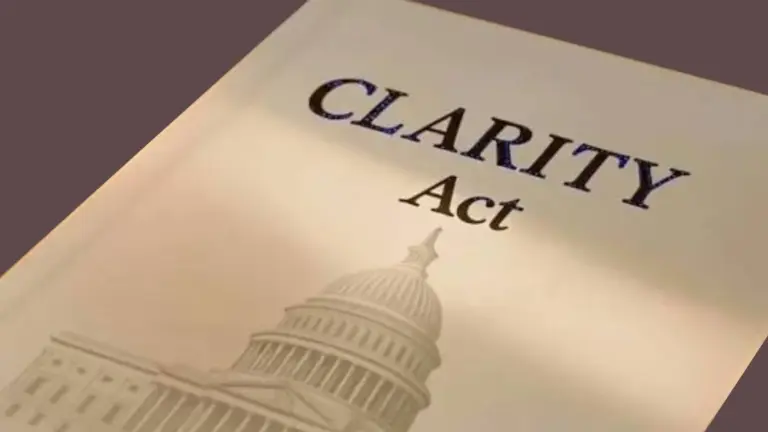
- Trump will meet Republican senators as the CLARITY Act nears a Senate floor vote expected the week of July 20, needing 60 votes to pass.
- Democrats are demanding stronger ethics provisions after Trump’s disclosure reported more than $1.4 billion in 2025 crypto income.
- Kalshi traders put a 79% probability on a Senate vote before August recess, but only 36% odds the bill becomes law in 2026.
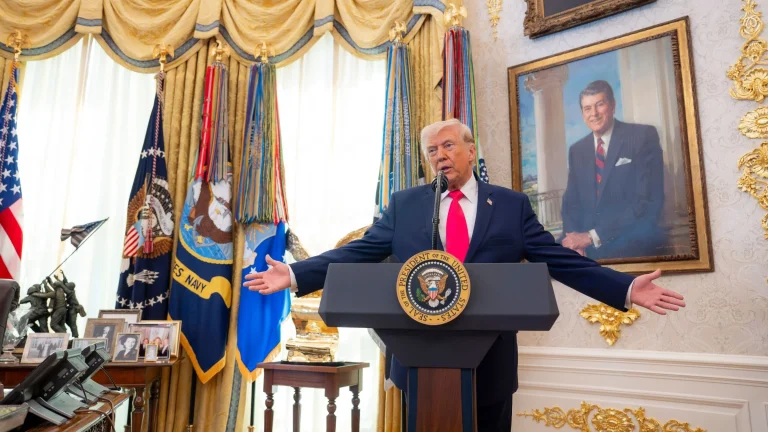
President Donald Trump is scheduled to meet with a group of Republican senators at the White House on Thursday to discuss the Digital Asset Market CLARITY Act, the crypto market structure bill lawmakers are racing to pass before the Senate’s August recess. The meeting comes as Democrats continue pressing for stronger conflict-of-interest provisions tied to Trump’s own crypto holdings, which his latest financial disclosure valued at more than $1.4 billion in 2025 income.
Senators To Brief Trump On The Bill’s Path Forward
Senator Bernie Moreno confirmed the White House meeting, saying senators plan to update the president on the legislation and its path to passage. Senator Cynthia Lummis, one of the bill’s lead architects, is also expected to attend. Senator Thom Tillis, who has worked through unresolved provisions, said he hopes to reach agreement among negotiators by the end of the week.
Lummis said on Fox Business that a revised draft of the bill will be introduced within days, with a Senate floor vote expected the week of July 20. The bill needs 60 votes to clear the Senate, meaning Republicans will need support from at least seven Democrats. Senate Majority Leader John Thune has said he intends to bring the bill forward this month regardless of whether every provision is finalized.
What The Bill Would Do
The CLARITY Act would divide regulatory oversight of digital assets between the Commodity Futures Trading Commission and the Securities and Exchange Commission, while establishing consumer protection standards for crypto exchanges and issuers.
The House passed its version of the bill, H.R. 3633, by a vote of 294 to 134 in July 2025. Negotiators have spent nearly ten months working through the Senate’s version, with unresolved disputes centered on stablecoin yield rules, legal protections for non-custodial software developers, and the ethics language now at the center of this week’s talks.
Prediction Markets Show Rising Odds Of A Vote
Traders on Kalshi placed a 79% probability on the CLARITY Act receiving a Senate vote before the August recess as of Wednesday, up from 68.8% a day earlier.
Confidence that the bill becomes law this year is considerably lower: Kalshi traders put the odds at 36% for 2026 passage, rising to 62% by the end of 2027. Polymarket traders separately priced the odds of the bill being signed into law this year at 39%.
Ethics Provisions Remain The Central Sticking Point
Democrats have demanded explicit restrictions preventing the president, vice president, members of Congress and their immediate families from financially benefiting from crypto businesses subject to the bill’s new rules. Senators Ruben Gallego and Angela Alsobrooks, both Democrats who voted for the bill in committee, have said their committee votes do not guarantee support on the floor without a resolved ethics provision. Closed-door negotiations on that language broke down in early June.
Senator Chris Murphy escalated criticism of the bill on July 14, arguing in a social media post that industry-backed legislation would expand crypto’s reach into the banking system while doing too little to prevent officials from profiting off businesses they regulate.
Murphy said the bill, in its current form, would “essentially legalize” what he described as improper crypto dealings by the president, a characterization the White House has not endorsed. Other Senate Democrats have separately pushed for hearings into the president’s crypto holdings.
Democrats Point To Trump’s $1.4 Billion Crypto Disclosure
Trump’s 927-page annual financial disclosure, filed with the U.S. Office of Government Ethics and released July 1, reported more than $1.4 billion in cryptocurrency-related income for 2025, making digital assets the largest single source of his reported earnings that year. The filing showed more than $635 million tied to sales of his branded meme coin and roughly $515 million to $594 million from World Liberty Financial, the crypto venture Trump co-founded with his sons.
Five senior Senate Democrats, including Elizabeth Warren, the ranking member of the Senate Banking Committee, cited the $1.4 billion figure in a letter renewing their request for hearings into the president’s crypto holdings. The letter also pointed to a reported 49% stake in World Liberty Financial held by investors linked to the United Arab Emirates. Trump has defended the ventures, telling an interviewer there was nothing improper about them and saying his son Eric Trump oversees the assets through a trust structure. The White House has said Trump’s business interests do not create conflicts under that arrangement.
Industry groups, including executives at Coinbase, continue to back the legislation, arguing that clear federal rules are needed to keep U.S. crypto markets competitive with regulatory frameworks already in place in the European Union and China.