
Hackers Use Ethereum Smart Contracts to Hide Malware in Open-Source Repositories
Overview
Cybersecurity researchers have discovered a new method of distributing malware that leverages Ethereum smart contracts, marking...
Search Coin Insider
Sign in to Coin Insider
Save articles, track what you read, and manage email preferences.
Continue with GoogleWe will email you a verification link. You must confirm your email before you can sign in.
Ethereum is preparing for its next significant network milestone: the Fusaka hard fork, slated for early November 2025, just in time for the global Devconnect conference in Buenos Aires.
While not as headline-grabbing as May’s Pectra upgrade, Fusaka may be just as consequential, if not more so, because it strengthens Ethereum’s core performance behind the scenes.
Unlike Pectra, which delivered visible features such as account abstraction and higher staking limits, Fusaka is infrastructure-focused. It bundles 11 Ethereum Improvement Proposals (EIPs), prioritizing scalability, efficiency, and node resilience while leaving smart contracts untouched.
For users, that means fewer flashy changes in wallets or DApps. For Ethereum’s foundation, it means the plumbing that keeps the world’s largest innovative contract platform running gets sturdier and faster.
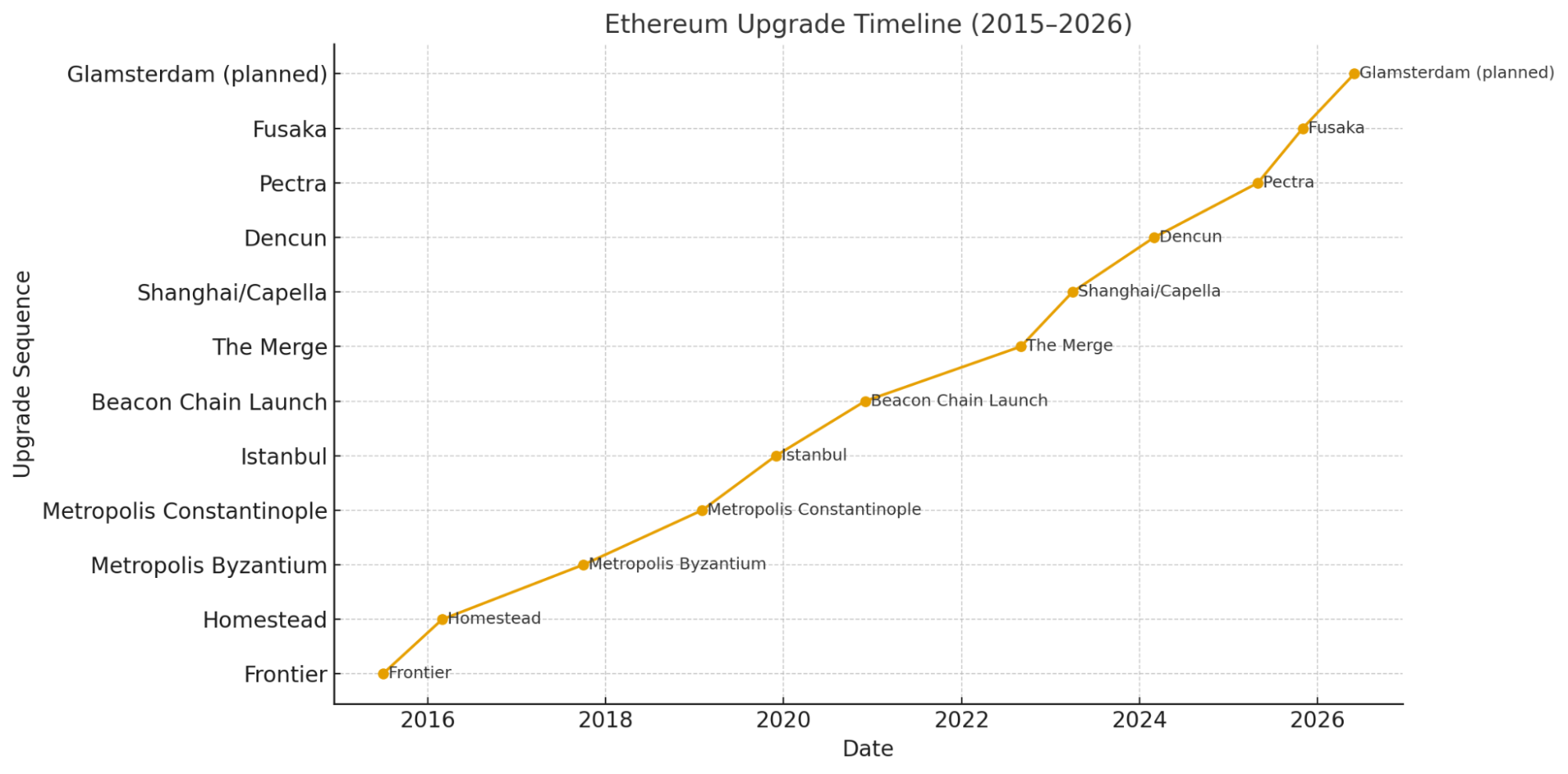
Ethereum’s development pace has accelerated. Core contributors are working on a semiannual rhythm: two yearly upgrades, each balancing ambition and stability. Fusaka arrives barely six months after Pectra and on the heels of intensive testing.
Ethereum’s developers locked Fusaka’s scope on August 1, freezing the feature set to allow six weeks of cross-client checks, bug bounties, and release polishing. The result is a leaner, more predictable process – a far cry from the chaotic upgrade schedules of Ethereum’s early years.
As one protocol contributor bluntly put it during the AllCoreDevs call:
“If we want to ship by Devconnect, we need our timeline TIGHT.”
The urgency reflects Ethereum’s evolving culture: agile, but disciplined.
At its heart, Fusaka is about tuning Ethereum’s engine, not remodeling the house. The bundled proposals don’t disrupt smart contracts or app compatibility but reshape how Ethereum handles transactions, data, and validation. Here are the standouts:
Other proposals tweak blob pricing, cap block sizes, and introduce new opcodes for cryptography and compression. Collectively, they amount to Ethereum’s most significant performance tune-up since The Merge.
Notably, heavier changes like the EVM Object Format and EIP-7907 were deliberately omitted. By keeping Fusaka focused, developers aim for a smooth rollout with minimal surprises.
For developers and users, Fusaka promises benefits that will largely go unnoticed: steadier gas fees, smoother performance during congestion, and more predictable rollup costs.
But every optimization comes with trade-offs. Larger blocks and higher gas ceilings raise demands on storage and bandwidth, which could strain smaller validators and tilt the network toward industrial-scale operators. Ethereum’s challenge has always been to balance performance with decentralization, and Fusaka continues that delicate dance.
Even with Fusaka, Ethereum’s throughput remains modest compared to traditional payment networks. At current settings (~36M gas limit and 12-second block time), Ethereum can process roughly 142 transactions per second. Visa, by contrast, can handle thousands.
By gradually raising gas limits and exploring future block-time reductions, Ethereum is edging closer to higher throughput. Fusaka lays the groundwork; the bigger leaps may come next.
While Fusaka is being finalized, Ethereum’s gaze is already turning to the Glamsterdam upgrade in 2026. That release could introduce EIP-7782, a proposal to cut block times from 12 seconds to 6. Such a move would effectively double throughput, making Ethereum transactions feel faster and more responsive, especially for wallets and layer-2 users.
Other future discussions include:
These conversations will crystallize at upcoming AllCoreDevs meetings, underscoring Ethereum’s transparent, iterative approach to governance.
The choice to schedule Fusaka just before Devconnect is no accident. Ethereum’s community gathers at the annual developer conference to share progress, roadmap updates, and research breakthroughs. Shipping Fusaka before the event ensures that discussions focus on what comes next, rather than what’s still unfinished.
It also signals confidence: Ethereum’s developers are showing they can innovate and deliver reliably on a timetable. In the blockchain world, where delays and resets are common, consistency is valuable.
Fusaka won’t grab headlines with flashy new wallet features or radical user-facing changes. Instead, it represents something equally important: Ethereum’s commitment to steady, disciplined refinement of its foundation.
By bundling 11 back-end improvements into a stable package, Fusaka strengthens the network’s scalability, security, and efficiency – without disrupting DApps or contracts. It is Ethereum’s quiet workhorse upgrade, laying the tracks for more ambitious proposals in 2026 and beyond.
In Vitalik Buterin’s words, Ethereum evolves by “iterating, improving, and making space for the next leap.” Fusaka embodies that ethos: tighten the bolts today, so tomorrow’s breakthroughs have room to run.
Overview
Cybersecurity researchers have discovered a new method of distributing malware that leverages Ethereum smart contracts, marking...
If you are interested in CFD trading and wanting to learn how to make money from trades, here are a few tips and tricks to help.
One of the quickest growing Bitcoin mining firms Cipher has announced the nearly billion-dollar acquisition of Bitmain Antminer T21 miners.
Broadening the Spectrum of Cryptocurrency Journalism
CoinInsider.com, a foremost gateway into the intricate realm of cryptocurrency,...