
Bitcoin mining difficulty jumps 15% as hashrate rebounds

Angelina Reinhard
- 2 min read
Key Takeaways
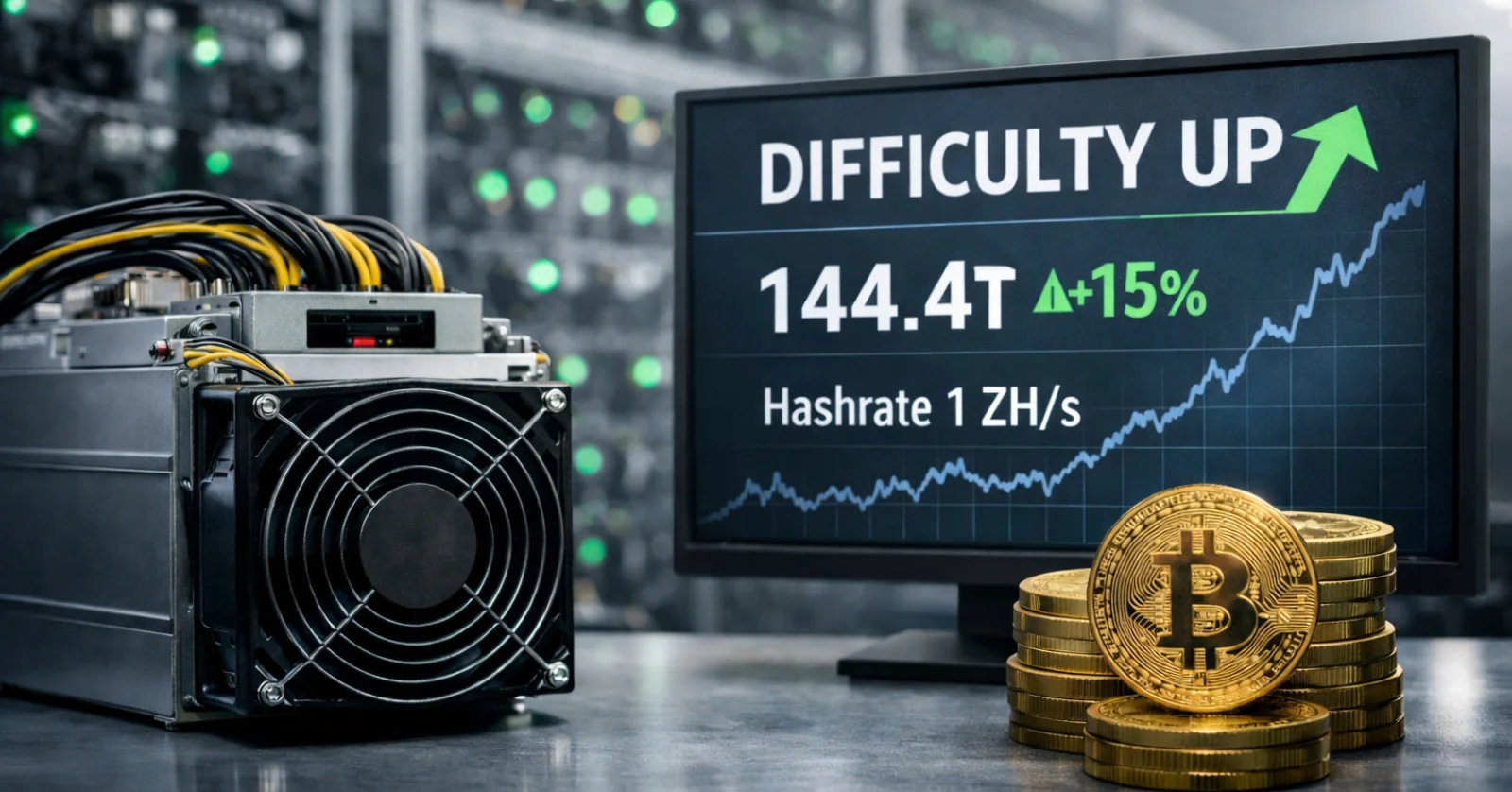
- Bitcoin mining difficulty jumped 15% to 144.4T, the biggest rise since 2021
- Hashrate rebounded near 1 ZH/s after the storm-driven dip
- Hashprice around $24 per PH/s/day keeps miner margins tight as AI and HPC shift grows
Bitcoin’s latest difficulty adjustment lifted the network to 144.4T, a 15% jump and the biggest upward reset since 2021.
The increase comes during a weak tape for Bitcoin, with mining revenue per unit of compute near multi-year lows. The network is becoming harder to mine at a time when margins are already tight.
The move reflects a rapid recovery in hashrate after a storm-driven dip earlier this year, and it highlights how quickly mining competition can return even when price is under pressure.
Increased difficulty pushes mining competition to its highest level in months
The 15% rise follows a sizable downward adjustment earlier in February. That decline came after blocks slowed during a sudden hashrate pullback, which briefly eased competition for miners that stayed online.
Difficulty adjusts every 2,016 blocks, roughly every two weeks. When blocks are found faster than the protocol target, difficulty moves up at the next reset.
A jump of this size has been rare outside of major network disruptions. The last comparable period was 2021, when China’s crackdown forced a large share of mining to relocate, and the network went through large swings before stabilizing.
Hashrate rebounds after storm disruptions and U.S. curtailments
Network hashrate has climbed back to around 1 zettahash per second, reversing a dip that took estimates down into the mid-800 exahash range earlier this month.
The pullback followed sharp price weakness and a period where US-based miners reduced output during severe winter conditions to manage grid strain and power costs. As facilities restarted and machines returned to full load, block production sped up again, setting up the largest difficulty jump in years.
Hashprice of $24/PH/s/day keeps miner revenues under strain
Hashprice, a standard measure of daily miner revenue per unit of hashrate, has been sitting near multi-year lows. Recent readings have hovered around the low-to-mid $20s per PH/s/day.
A higher difficulty setting tightens the math further. Miners need more compute to earn the same share of block rewards, and they feel the pressure most when fees are soft and power costs are high.
Bitcoin’s price rebound toward the high-$60,000s has not fully offset the margin hit from lower hashprice and rising difficulty. Operators with older fleets or expensive power face the biggest strain.
Low-cost miners keep hashrate high despite thin margins
A large share of the hashrate recovery has come from miners that can run at a lower cost. They have cheap electricity, newer ASIC machines, and enough scale to stay online even when hashprice is weak.
Some mining activity is also linked to state-backed or strategic players that can tolerate thinner margins. On-chain tracking tied to a UAE royal-linked mining operation shows holdings of roughly 6,782 BTC, with unrealized gains estimated around $344 million at current prices, before energy costs.
Together, that helps explain why the network can stay highly competitive during a price slump. Higher-cost miners may slow down or shut off machines, but the bigger, cheaper operators keep the baseline hashrate from falling as much.
Miners chase AI/HPC hosting as mining economics tighten
Public miners are increasingly treating power access and data center footprint as the main asset. Several companies are directing capital toward AI and high-performance computing hosting, where long-term contracts can offer steadier cash flow than Bitcoin mining.
Bitfarms has announced plans to redomicile in the US and rebrand as Keel Infrastructure as it shifts toward AI-focused data center development. Riot Platforms is facing pressure from activist investor Starboard to accelerate AI and HPC deals, following its recent agreement to lease capacity to AMD at a Texas site.
The pivot does not remove mining from the equation, but it changes how operators allocate power and investment. In a low-hashprice environment, competition between mining and AI workloads is becoming a core strategic decision.
Efficiency, financing, and power strategy will decide who can keep scaling
This difficulty jump does not change the protocol’s incentives, but it does raise the standard for operational discipline.
Miners that can secure stable power pricing, run efficient fleets, and finance upgrades without stressing balance sheets are positioned to keep adding hashrate. Everyone else is competing in a tougher field until either hashprice improves or the network eases at a later retarget.
Categories:
Angelina Reinhard
Crypto Journalist & Market Analyst
Angelina is a crypto journalist and market analyst covering blockchain innovation, digital asset markets, and emerging industry developments. She focuses on clear, structured reporting that breaks down complex topics into accessible insights for a global audience.
Her work explores market movements, technological trends, and the evolving landscape of the cryptocurrency industry through timely, reader-focused news coverage.