

Key Takeaways
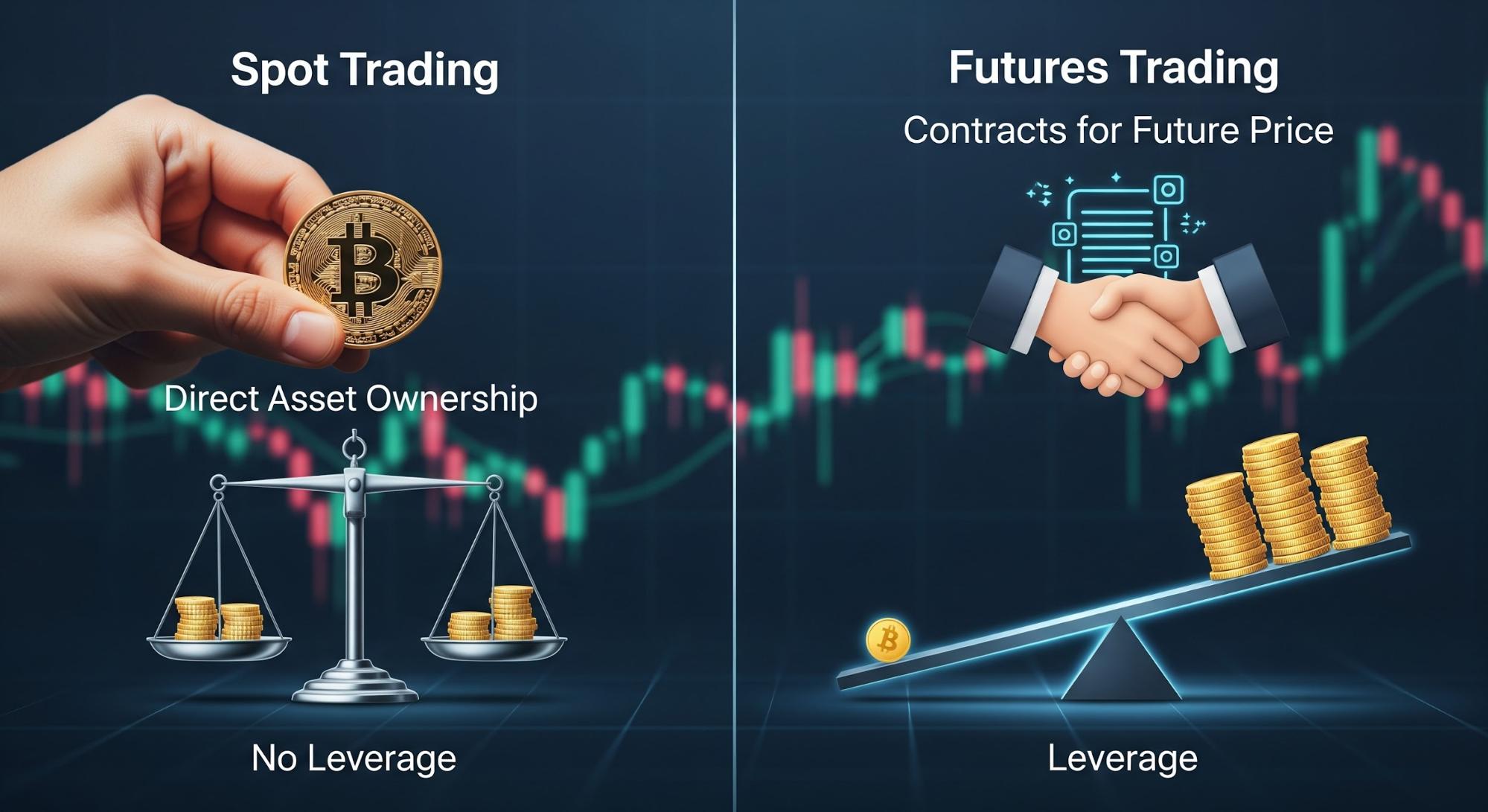
- Spot trading = buy/sell crypto at the current price, gain direct ownership, simpler & lower risk.
- Futures trading = contracts to speculate on price (long/short), no asset ownership, higher risk but more flexibility.
- Leverage: Not available in spot; futures allow high leverage (5x–125x), amplifying gains/losses.
- Risk: Spot limited to initial investment; futures risk liquidation and margin calls.
- Time horizon: Spot suits long-term investing; futures are better for short-term trading & hedging.
- Liquidity: Spot varies by coin; futures are usually more liquid for major assets.
- Costs: Spot = trading fees only; futures = fees + funding rates, margin interest, liquidation costs.
- Pricing: Spot follows real-time market; futures reflect expectations (contango/backwardation).
- Regulation/Taxes: Spot is usually taxed as capital gains; futures are treated as derivatives with different tax rules.
- Best fit: Spot is best for beginners, long-term holders, and those with a lower risk tolerance. Futures are best for experienced traders, short-term speculators, and hedgers.
Overview
cryptocurrency trading isn’t just about choosing which coin to buy; it’s also about deciding how to trade it. Among the most common approaches are spot trading and futures trading, two methods that work very differently yet are often compared side by side.
Spot trading is simpler: you buy or sell crypto at its current market price and gain direct asset ownership. On the other hand, futures trading involves contracts that let you speculate on a cryptocurrency’s price movement without ever holding the coin itself.
Understanding the differences between these two markets is essential for anyone navigating the crypto world, whether you’re a beginner looking to build a long-term portfolio or a trader exploring leveraged strategies. Knowing how spot vs. futures trading works will help you choose the right approach for your goals.
In this guide, we’ll explain spot and futures trading, highlight their pros and cons, and compare them across ownership, leverage, risk, fees, and more, so you can make informed decisions in the fast-moving crypto space.
What Is Spot Trading?
Spot trading is the most straightforward way to trade cryptocurrency. It involves buying or selling digital assets at the current market price, also known as the spot price. Once the trade is executed, ownership of the asset transfers immediately – meaning you truly hold the crypto in your wallet and can store, transfer, or sell it whenever you choose.
For example, if Bitcoin is trading at $27,000 and you purchase one Bitcoin on a spot exchange, you now own that Bitcoin outright. The transaction settles instantly; no contracts, expiries, or conditions are attached.
Advantages of Spot Trading
- Simplicity: Spot trading is beginner-friendly and easy to understand – you buy low, sell high.
- Transparency: Prices reflect real-time supply and demand in the market.
- Real Ownership: Traders can withdraw and hold their crypto in personal wallets.
- Lower Risk: Losses are limited to the amount invested, with no margin calls or liquidation risks.
- No Expiry: You can hold assets indefinitely, making spot trading well-suited for long-term investing.
Disadvantages of Spot Trading
- Capital-Intensive: You must pay the full price of the asset upfront – no leverage is available.
- No Hedging Tools: Unlike futures, spot trading doesn’t allow you to profit from falling prices.
- Exposure to Volatility: Because crypto prices fluctuate sharply, your holdings can lose value quickly.
- Liquidity Concerns: Some smaller tokens may have low liquidity, making it harder to buy or sell at desired prices.
In short, spot trading is ideal for investors who want simplicity, transparency, and direct ownership of crypto assets. However, it also requires significant capital and doesn’t offer the advanced tools that futures trading provides.
What Is Futures Trading?
Futures trading works differently from spot trading. Instead of buying or selling a cryptocurrency directly, traders enter into a contract to purchase or sell the asset at a predetermined price on a future date. In crypto markets, this often takes the form of futures contracts or perpetual swaps.
With futures, you don’t actually own the underlying cryptocurrency. Instead, you’re trading on its price movements. For example, if Bitcoin is currently at $27,000 and you believe it will rise, you could enter a futures contract to “go long.” If the price climbs to $30,000, you profit from the difference – without ever holding Bitcoin in your wallet. Conversely, you can “go short” and profit when prices fall.
Advantages of Futures Trading
- Leverage: Futures allow you to control larger positions with a smaller initial investment. Some exchanges offer leverage from 5x up to 100x.
- Long and Short Opportunities: Traders can profit from rising and falling markets.
- Hedging: Futures contracts can offset risk, making them useful for miners, institutions, or investors protecting their portfolios.
- Liquidity: Futures markets often have high trading volumes and tight spreads, especially for major coins like Bitcoin andEthereum.
- Efficiency: No need to handle wallets or transfers since contracts don’t involve direct asset ownership.
Disadvantages of Futures Trading
- Liquidation Risk: If the market moves against your position, losses can exceed your initial margin and result in forced liquidation.
- Complexity: Futures require an understanding of margin, leverage, funding rates, and risk management strategies.
- Margin Requirements: You must maintain sufficient collateral to keep your position open.
- Expiry Dates (for some contracts): Standard futures have set expiration dates, unlike perpetual swaps, which never expire but include funding costs.
In essence, futures trading provides advanced tools for speculation and hedging but comes with higher complexity and risk. It’s often favored by active traders who seek short-term opportunities rather than long-term holders.
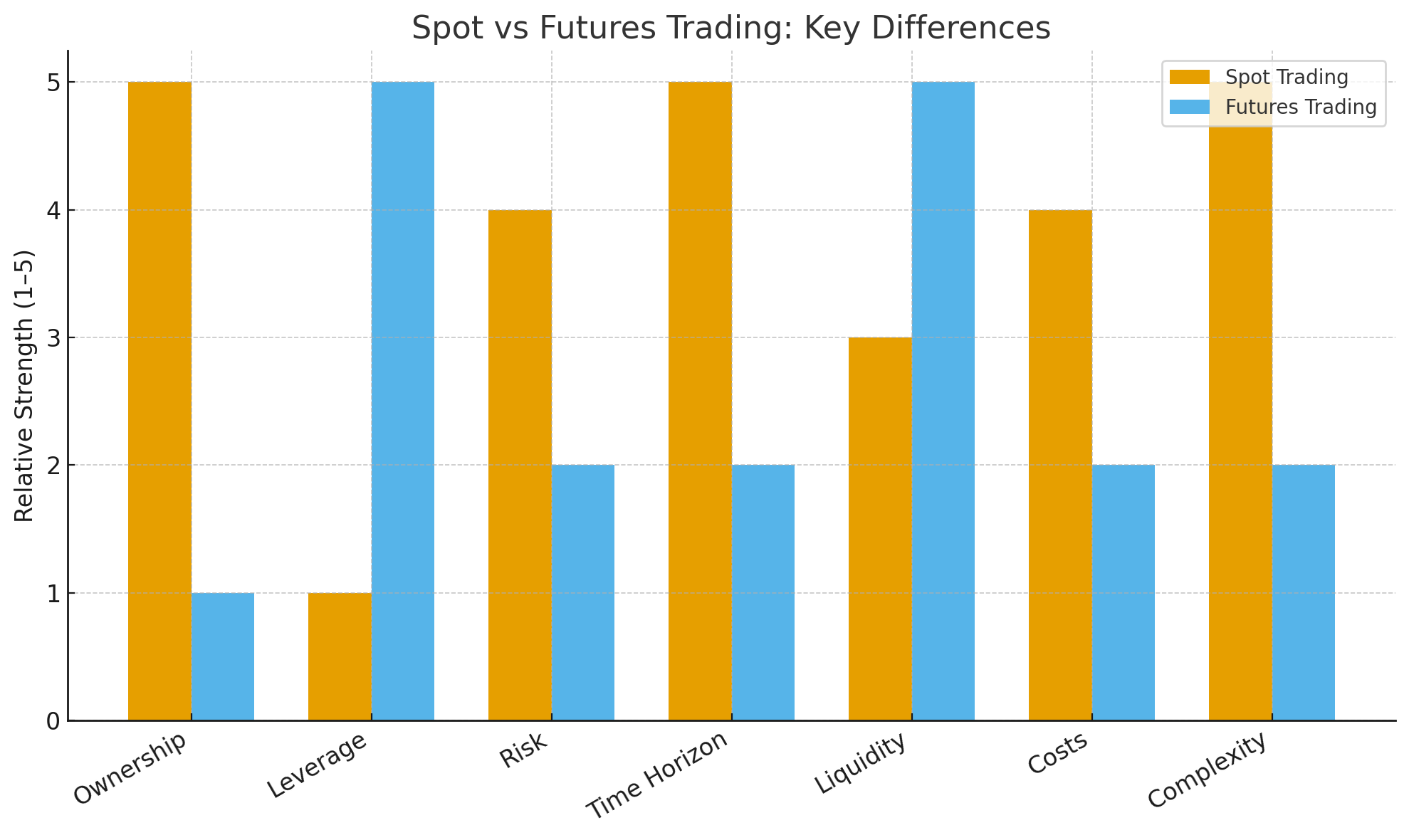
Spot vs Futures: Key Differences
Now that we’ve covered the basics of spot and futures trading, let’s compare them. While both allow traders to engage with the crypto market, the mechanics, risks, and goals behind them are very different.
Quick Comparison Table
| Feature | Spot Trading | Futures Trading |
| Transaction | Buy/sell crypto directly at the current market price | Trade contracts tied to future prices (or perpetual swaps) |
| Ownership | You own the actual crypto asset | You own a contract, not the underlying coin |
| Price | Based on real-time market price (spot price) | Based on expectations, can differ from spot price |
| Leverage | No leverage (you trade only what you own) | High leverage available (5x–125x on many exchanges) |
| Risk | Limited to your initial investment | Higher risk from leverage, liquidation, and margin calls |
| Expiry | No expiry – you can hold assets indefinitely | Standard futures expire; perpetual contracts don’t, but carry funding costs |
| Objective | Best for long-term investing and asset ownership | Best for speculation, hedging, or short-term profit strategies |
Summary
In simple terms, spot trading is straightforward and lower-risk, giving you direct ownership of crypto you can hold as long as you want. Futures trading is contract-based, leveraged, and more complex, offering advanced tools for speculation or hedging but also exposing traders to greater risks.
Ownership of Assets
One of the most apparent distinctions between spot and futures trading is who holds the crypto asset.
Spot Trading: You gain absolute cryptocurrency ownership when you buy on the spot market. You can withdraw it to your wallet, transfer it, or hold it as a long-term investment. For example, purchasing 1 ETH on a spot exchange means owning that ETH.
Futures Trading: With futures, you don’t own the underlying cryptocurrency. Instead, you hold a contract representing a bet on the asset’s future trading price. You can’t withdraw a futures contract into a wallet – it only exists within the exchange. Your exposure is purely to the price movements, not the asset itself.
This difference matters for investors who value custody and long-term ownership. Spot traders can build a portfolio of assets, while futures traders are only ever exposed to contract performance.
Use of Leverage
Leverage is one of the most significant differences between spot and futures trading.
Spot Trading: You can only trade using your own funds in the spot market. If you have $1,000, you can buy up to $1,000 worth of Bitcoin – no more. This makes spot trading more conservative and straightforward, since your exposure is limited to your capital.
Futures Trading: Futures allow traders to amplify their positions using leverage. Depending on the exchange, leverage can range from 5x to 125x, meaning you can control much larger trades with a fraction of the capital. For instance, with $1,000 and 10x leverage, you could open a $10,000 position.
While leverage can multiply profits, it also magnifies losses. A small market move in the wrong direction can quickly wipe out your margin and lead to liquidation. That’s why leverage is both a powerful tool and a significant risk factor in futures trading.
Risk Profile
The level and type of risk differ greatly between spot and futures trading.
Spot Trading: Risk is limited to the amount you invest. If you buy $1,000 worth of Bitcoin and the price drops by 50%, your holdings are worth $500 – but you still own the asset, and there’s no risk of losing more than your initial outlay.
Futures Trading: Futures carry higher and more complex risks. Because of leverage, even small price swings can trigger margin calls or liquidation, where the exchange closes your position to prevent further losses. For example, with 10x leverage, a mere 10% price move against your trade could wipe out your entire margin.
This makes spot trading inherently safer for beginners or long-term investors, while futures demand careful risk management and a strong understanding of market volatility.
Liquidity & Market Depth
Liquidity – how easily assets can be bought or sold without affecting price – also differs between spot and futures markets.
Spot Trading: Liquidity varies widely depending on the cryptocurrency. Major coins like Bitcoin and Ethereum generally have deep spot markets. At the same time, smaller Altcoinscan suffer from thin liquidity, leading to slippage (where your trade executes at a worse price than expected).
Futures Trading: Futures markets for top cryptocurrencies often have higher liquidity and tighter spreads than their spot counterparts. This makes them attractive for active traders seeking quick execution. However, futures markets also introduce variables like funding rates – periodic payments between long and short traders that can impact costs and short-term liquidity conditions.
In short, spot liquidity depends heavily on the coin itself, while futures liquidity tends to be more consistent – especially for high-volume assets – but comes with additional cost factors.
Trading Objectives
The goals behind spot and futures trading usually differ, and understanding these objectives helps traders choose the right approach.
Spot Trading is best suited for investors who want to own crypto outright and hold it for the long term. The objective is typically wealth accumulation and participation in the growth of the cryptocurrency market over time. For instance, a Bitcoin trader might buy and hold for years, expecting its value to increase.
Futures Trading is designed for traders seeking short-term opportunities, speculation, or hedging. Futures allow you to profit whether prices rise or fall, making them a favorite tool for active day traders. Institutional players or miners also use them to hedge against market volatility. For example, a miner might short Bitcoin futures to lock in a selling price for coins they will mine in the future.
Spot is about building ownership and long-term value, while futures focus on managing risk or maximizing short-term profit potential.
Cost and Fees Comparison
The costs involved in spot and futures trading can look similar at first glance but differ in meaningful ways.
Spot Trading: Most spot exchanges charge maker and taker fees (often between 0.1% and 0.5% per trade, depending on the platform). Since there’s no leverage, you don’t pay interest or extra funding costs. The simplicity of the fee structure makes spot markets easier for beginners to navigate.
Futures Trading: While futures also charge maker/taker fees, they often include additional costs:
- Funding Rates: In perpetual futures, longs and shorts periodically pay each other depending on market conditions. This can make holding positions costly over time.
- Margin Interest: Some platforms charge for borrowed funds used in leveraged trading.
- Hidden Costs: Liquidation penalties and slippage in highly volatile conditions can increase trading expenses.
Spot trading is usually more cost-efficient for traders holding long-term positions. Futures, while powerful, can rack up costs quickly, especially when using high leverage or keeping contracts open for extended periods.
Pricing Differences
Another key distinction between spot and futures trading lies in determining prices.
Spot Price: This is the current market price of a cryptocurrency, reflecting real-time supply and demand. If Bitcoin trades at $27,000, that’s its spot price – the amount you’ll pay (plus fees) to buy it immediately.
Futures Price: Futures contracts are priced differently because they factor in expectations of where the market is heading, plus costs like funding rates and the cost of carry (storage, capital, or interest considerations). As a result, futures prices can be higher or lower than the spot price.
- Contango: When futures prices are higher than spot prices (often in bullish markets).
- Backwardation: When futures prices are lower than spot prices (often in bearish or high-demand conditions).
For example, if Bitcoin trades at $27,000 (spot), but a 3-month futures contract is priced at $28,000, the market is in contango. This gap reflects traders’ belief that Bitcoin’s price will rise over time.
Spot trading always follows the here and now, while futures pricing reflects market sentiment and future expectations.
Choosing the Right Trading Approach: Spot or Futures?
Deciding between spot and futures trading depends mainly on your risk tolerance, investment goals, experience, and capital. Both methods can be profitable, but they cater to different types of traders.
Spot Trading Is Best For:
Traders who prefer lower risk and no exposure to liquidation – i.e., beginners who want simplicity and direct ownership of crypto, and long-term investors who believe in the growth of digital assets and want to hold them indefinitely.
Example: Alice buys Ethereum on the spot market, transfers it to her wallet, and plans to hold it for five years as part of her portfolio.
Futures Trading Is Best For:
Active day traders looking to profit from both upward and downward price swings, experienced traders comfortable with leverage, advanced strategies, etc., and investors or miners who want to hedge against volatility.
Example: A Bitcoin miner shorts futures contracts to lock in a guaranteed selling price for the coins they expect to mine in the coming months.
Key Considerations
- Risk Tolerance: Spot is lower risk; futures amplify gains and losses.
- Capital Needs: Spot requires full payment upfront; futures allow smaller capital outlay but involve margin requirements.
- Time Horizon: Spot suits long-term strategies; futures are designed for short- to medium-term trades.
In short, spot trading is like buying and holding for growth, while futures trading is about strategizing and speculating on market moves. Choosing the right one depends on whether your goal is steady accumulation or active trading.
Understanding Taxes and Regulations
Another important factor when comparing spot and futures trading is how they are taxed and regulated. While rules vary by country, there are some general differences traders should keep in mind.
Spot Trading: When you buy and later sell crypto in the spot market, any profits are usually subject to capital gains tax. The tax rate often depends on how long you held the asset – in some regions, long-term holdings are taxed at lower rates than short-term trades. Because you own the underlying crypto, additional rules around custody, reporting, and transfers may also apply.
Futures Trading: Futures are often regulated differently because they are considered derivatives. Taxes may apply not only to gains but also to the leveraged nature of trades. For example, in the U.S., crypto futures traded on regulated exchanges may fall under Section 1256, which splits gains between short-term and long-term tax rates, regardless of the contract’s duration. In other countries, futures may face stricter margin or reporting rules.
Regulatory Oversight: Spot trading platforms must typically comply with KYC (Know Your Customer) and AML (Anti-Money Laundering) regulations. Futures platforms, particularly those offering high leverage, are often subject to additional regulatory scrutiny or may not be available in all jurisdictions.
Important Note: Tax laws and regulations differ widely by country and can change quickly. This section is for educational purposes only. Traders should consult with a qualified tax professional for personalized guidance.
Charting & Technical Tools for Spot vs Futures
Analyzing price movements is essential to trading, but the tools and metrics you’ll use can differ depending on whether you’re trading spot or futures.
Spot Trading Tools: Spot traders rely on simpler, long-term technical analysis. Common tools include:
- Price Action & Trendlines: Identifying upward or downward trends.
- Moving Averages: Tracking average prices to spot momentum shifts.
- Volume Indicators: Assessing buying and selling activity.
- Basic Chart Patterns: Support/resistance levels, head-and-shoulders, triangles, etc.
These tools work well for investors building positions over weeks, months, or years.
Futures Trading Tools: Futures markets introduce additional data points that matter in leveraged or contract-based trading. Key metrics include:
- Open Interest: The number of active contracts, which shows market participation.
- Funding Rates: Regular payments between longs and shorts in perpetual futures, signaling sentiment and costs of holding positions.
- Liquidation Heatmaps: Visualizing where prominent positions may be forced to close, helping traders anticipate volatility.
- Advanced Indicators: Tools like the Relative Strength Index (RSI), Bollinger Bands, or MACD are often combined with futures-specific metrics for short-term decision-making.
In short, spot traders focus on long-term price trends and accumulation, while futures traders need advanced, real-time metrics to manage leverage, funding costs, and rapid market moves.
Frequently Asked Questions (FAQs)
Futures contracts allow traders to control prominent positions with a small margin deposit. This structure allows traders to offer leverage (5x–125x), which is not available in spot trading. Spot trading requires full payment upfront, so leverage isn’t built into the system.
Yes. The concept of spot markets applies beyond crypto. Commodities like gold, oil, and agricultural products also have spot markets, where assets are bought and sold for immediate settlement at the current market price.
Generally, yes. Spot trading carries lower risk because losses are limited to the amount you invest, and there’s no liquidation risk. Futures can be riskier due to leverage, margin calls, and funding rate costs, which can quickly magnify losses.
Spot trading profits are usually taxed as capital gains, depending on the holding period. Futures, as derivatives, can be taxed differently - sometimes with blended or preferential tax treatment, depending on local laws. Always check with a tax professional in your jurisdiction.
No. While most exchanges offer futures for major coins like Bitcoin and Ethereum, not all cryptocurrencies have active or liquid futures markets. Futures are generally reserved for high-volume assets.
Not always. Traditional futures have fixed expiry dates, but perpetual futures (or perpetual swaps) never expire. Instead, they use funding rates to keep prices aligned with the spot market.
Not directly. Spot and futures are separate markets. However, many exchanges that offer both allow traders to sell their spot holdings and open a futures position. Some even provide features to transfer balances between accounts to make the process smoother.
Why is futures trading more leveraged than spot trading?
Can you trade commodities in the spot market?
Is spot trading safer than futures trading?
What are the tax differences between spot and futures trading?
Are futures markets available for all cryptocurrencies?
Do future contracts always have an expiration date?
Can I switch from a spot to a futures position easily?